Showing posts with label risk management. Show all posts
Showing posts with label risk management. Show all posts
6/05/2010
Compliance
Since I've now begun to expropriate other peoples blogs with trading thoughts I guess I should just grow up and return to an open discussion in this blog.
That includes trading.
Either that or just delete the whole thing and go away.
Na.
What has got me talking you may ask?
Since I quit talking about trading roughly 3 months ago I have come to one very important conclusion about this business. It's nothing new or revolutionary, it is a very common issue known by all traders.
Compliance.
"In general, compliance means conforming to a rule, such as a specification, policy, standard or law." Wikipedia
We all know that you cannot trade without a plan. So we make a plan. Then we do not comply with our plan.
Why?
Why indeed.
Jules got me thinking about my Myers Briggs personality type again, and LW got me thinking about my identity as a trader.
These thoughts took me back to my very rational thoughts that should have insured my compliance issues were all taken care of. I wrote about them, therefore they must be "handled".
Know Thyself
Whose Game are You Playing?
Well, they're not "handled".
How do I know this?
I track the trade results of all valid patterns.
IB tracks the trade results of all the "patterns".
In May there was a 91 tick difference between IB's statement and my "statement".
I don't need to tell you that my "statement" was the one with the 91 extra ticks.
So being a rational INTJer I made note of this, I stated this is unacceptable, these are not the actions of a professional trader, this is amateur stuff.
I was going to make this note to self a note to you in a blog at the end of May. State publicly my disgrace and ask you to hold me accountable for the month of June.
Accountable to the plan.
Or
In compliance.
But I didn't write the post, instead I told myself to just do it. Stop being an idiot and only take valid patterns. How hard can that be? Just do it. The math is right in front of you, you are not smarter than the market, you are not smarter than the plan, you made the plan, you traded full time for 3 years building the plan, the plan works, trade the plan.
Right.
June 1.
Traded the plan. I am in compliance. Go eat ice cream.
Good boy.
June 2.
Took non valid trade.
CAN'T EVEN DO TWO BLOODY DAYS!
So, here we are. Once you enter the world of non compliance you lose all sense of right and wrong. You are now an outlaw, living on the edge, all the cool guys in movies live out here, no rules, take no prisoners, go ahead... make my day.
Today is June 5th, we've had 4 days of trading in June, my June IB statement has 21 ticks profit. My valid patterns only statement has 82 ticks profit. Those 82 ticks look nice, but we can't eat them.
My name is Solfest and I'm not in compliance.
I lie here under my desk waiting for the surprise audit. (old bankers joke)
I tell myself I'm an outlaw, women love outlaws, rules, we don't need no stinkin rules.
Except I'm not an outlaw. I'm a trader. Traders have a risk management department and a compliance department. Both are very angry with me.
There is now a letter in my file. I'm on notice, shape up or ship out.

6/15/2009
Stop
I'm reading Martin Schwartz's book, Pit Bull. His advice on capital preservation is reinforcing what I have been writing about in my last few posts. Here is some of his advice.

Pretty simple stuff.
So simple you could ignore it as you continue your hunt for the holy grail. I would advice you not to ignore it. I would advise you to read it again. I would advise you to take a look at your trading records. See any blow up days that ruined your day, week, or month? Would Marty's advice have been any help on those days?
Schwartz tells a story in the book of a day he was trading S & P futures and he kept adding to a losing short position. His wife, who normally worked with him, was not there that day as she went shopping for a mink coat. :) Marty stated his wife (risk manager) would never have let him get that far out on the wrong side of the market. After conferring with her and his mentor that night he closed out his losing position the next day for a loss of $800,000. He told his wife she better enjoy that $800,000 mink coat.
You cannot trade your way out of a losing day, week, or month. All you can do is limit your losses and wait for your set ups. Stop and wait, maybe the two most important words in trading.
Stop and wait.
Humans don't like to stop and wait. We want to go, and now.
I think the best quote from Marty is "take time off and let your intellect take charge of your emotions; the market will be there when you return."
The best way to end a losing streak is to cut your losses and divorce your ego from the game.Pit Bull: Lessons from Wall Street's Champion Day Trader
The best way to stop a losing streak is to STOP!
STOP THE LOSSES, STOP THE BLEEDING. Take time off and let your intellect take charge of your emotions; the market will be there when you return.
You can never shift from reverse to first gear without first going through neutral.
YOU MUST CHANGE THE DIRECTION OF BAD TRADING BY FIRST SHIFTING TO NEUTRAL.
YOU MUST STOP.
The most important thing is to protect your trading capital until you can regain your equilibrium.
Pretty simple stuff.
So simple you could ignore it as you continue your hunt for the holy grail. I would advice you not to ignore it. I would advise you to read it again. I would advise you to take a look at your trading records. See any blow up days that ruined your day, week, or month? Would Marty's advice have been any help on those days?
Schwartz tells a story in the book of a day he was trading S & P futures and he kept adding to a losing short position. His wife, who normally worked with him, was not there that day as she went shopping for a mink coat. :) Marty stated his wife (risk manager) would never have let him get that far out on the wrong side of the market. After conferring with her and his mentor that night he closed out his losing position the next day for a loss of $800,000. He told his wife she better enjoy that $800,000 mink coat.
You cannot trade your way out of a losing day, week, or month. All you can do is limit your losses and wait for your set ups. Stop and wait, maybe the two most important words in trading.
Stop and wait.
Humans don't like to stop and wait. We want to go, and now.
I think the best quote from Marty is "take time off and let your intellect take charge of your emotions; the market will be there when you return."
6/05/2009
Why you should not be a trader
Before I answer that statement let's have a look at why people want to be traders.
1) They can't sleep.
2) They just got fired.
3) They have never been hired.
4) They want to make lots of money.
5) They know a guy and he.......
6) They don't like their boss.
7) They don’t want to be "corporate".
8) They want to work when they feel like it.
9) They can do this work from the beach.
10) Women love traders.
Now let's have a look at what I think it takes to be a successful trader, or more precisely to become a successful trader.
1) A complete understanding and acceptance of risk management.
That's it?
Ok let me flesh that out a bit. I used to work as a lender in a bank. Banks have a department called risk management. The people that wind up there usually did not do so well in the sales (lending) side of the business. I wonder if they still call it sales? Never mind that's another topic.
Where were we? Oh yes risk managers, risk managers are generally men who are old, bald, ugly, have no friends, and don't do all that well in social situations. They are most comfortable in their 17th floor cubicle where they do not see any human life form other than their comrades.
What does this have to do with trading?
Nothing I just like making fun of risk managers.
No no no bear with me here. So I as the lender in the bank meet a client, the client tells me a very long story about why they need money for this great business idea they have. I fall for it hook line and sinker and spend the next 2 days writing up a credit request that I send to risk management.
Now the fun begins.
One of my "partners" in risk calls me up to "discuss" this proposal, they start out nicely enough as they have been taught to do after the Johnson incident. Then they forget all that partner crap and really start laying into me. Insufficient net worth, no current ratio, no experience, tough industry, won't withstand a cyclical downturn, debt service ratio too weak, why would I send this piece of crap down here and waste their time, how long have you been in this business you stupid moron.
All righty then.
Is there a point to all this?
There is, I have to stop crying first. Ok, I'm better now.
Let's get back to trading.
So I'm all set up, charts, broker, front end, Mark Douglas in hand, and now I see a "trade", WHAM I pull the trigger, SLAM hits my stop in 3 seconds, WHAM go again, I am a day trader and I am fast baby, SLAM hits my stop in 7 seconds, and on and on we go.
Now let’s add risk management. Remember all those annoying questions? How much capital do I have equals my position size. How many losing trades am I allowed to take? How many winning trades before I stop? What is that based on? What are my stops? When do I stop trading, daily stops, weekly stops, monthly stops, and on and on we go.
This is the reason why you should not be a trader. You are the risk management department. In banking the lender cannot be the risk manager or bad things happen. In our business the trader is the risk manager, and, bad things happen.
YOU MUST PRESERVE CAPITAL.
In my opinion that is the first and last thing all traders must think about. Not charts, not set ups, not what will I do with all my profit.
Capital preservation. It's not sexy, it's not fun, it's not exciting, and it has rules, rules that must be followed or you’re fired. In other words it's everything that you hated about your other job.
If you want a fun, exciting, and sexy job try on line poker.
If you want to be a trader/risk manager shave your head bald, insult all your friends until they leave, stop bathing, wear polyester, and sniff constantly.
There, you're ready to go.
1) They can't sleep.
2) They just got fired.
3) They have never been hired.
4) They want to make lots of money.
5) They know a guy and he.......
6) They don't like their boss.
7) They don’t want to be "corporate".
8) They want to work when they feel like it.
9) They can do this work from the beach.
10) Women love traders.
Now let's have a look at what I think it takes to be a successful trader, or more precisely to become a successful trader.
1) A complete understanding and acceptance of risk management.
That's it?
Ok let me flesh that out a bit. I used to work as a lender in a bank. Banks have a department called risk management. The people that wind up there usually did not do so well in the sales (lending) side of the business. I wonder if they still call it sales? Never mind that's another topic.
Where were we? Oh yes risk managers, risk managers are generally men who are old, bald, ugly, have no friends, and don't do all that well in social situations. They are most comfortable in their 17th floor cubicle where they do not see any human life form other than their comrades.
What does this have to do with trading?
Nothing I just like making fun of risk managers.
No no no bear with me here. So I as the lender in the bank meet a client, the client tells me a very long story about why they need money for this great business idea they have. I fall for it hook line and sinker and spend the next 2 days writing up a credit request that I send to risk management.
Now the fun begins.
One of my "partners" in risk calls me up to "discuss" this proposal, they start out nicely enough as they have been taught to do after the Johnson incident. Then they forget all that partner crap and really start laying into me. Insufficient net worth, no current ratio, no experience, tough industry, won't withstand a cyclical downturn, debt service ratio too weak, why would I send this piece of crap down here and waste their time, how long have you been in this business you stupid moron.
All righty then.
Is there a point to all this?
There is, I have to stop crying first. Ok, I'm better now.
Let's get back to trading.
So I'm all set up, charts, broker, front end, Mark Douglas in hand, and now I see a "trade", WHAM I pull the trigger, SLAM hits my stop in 3 seconds, WHAM go again, I am a day trader and I am fast baby, SLAM hits my stop in 7 seconds, and on and on we go.
Now let’s add risk management. Remember all those annoying questions? How much capital do I have equals my position size. How many losing trades am I allowed to take? How many winning trades before I stop? What is that based on? What are my stops? When do I stop trading, daily stops, weekly stops, monthly stops, and on and on we go.
This is the reason why you should not be a trader. You are the risk management department. In banking the lender cannot be the risk manager or bad things happen. In our business the trader is the risk manager, and, bad things happen.
YOU MUST PRESERVE CAPITAL.
In my opinion that is the first and last thing all traders must think about. Not charts, not set ups, not what will I do with all my profit.
Capital preservation. It's not sexy, it's not fun, it's not exciting, and it has rules, rules that must be followed or you’re fired. In other words it's everything that you hated about your other job.
If you want a fun, exciting, and sexy job try on line poker.
If you want to be a trader/risk manager shave your head bald, insult all your friends until they leave, stop bathing, wear polyester, and sniff constantly.
There, you're ready to go.
10/28/2008
The Risk Fallacy
"But all the drama and chaos of recent months obscures the most fundamental cause of the entire financial crisis: a basic misunderstanding of risk (abetted by heavy borrowing). The paradox is that Wall Street's strategy to avoid excessive risk - by dispersing it - ended up exacerbating precisely the problem it was designed to prevent." By Nomi Prins, Fortune
Click on the read more icon for the full Fortune story.
read more | digg story
Click on the read more icon for the full Fortune story.
read more | digg story
9/02/2008
In Trading Hope is a Four Letter Word
Let's see my quote as of 6:51 am was, "hopefully the best trading is not done for the day".
Right.
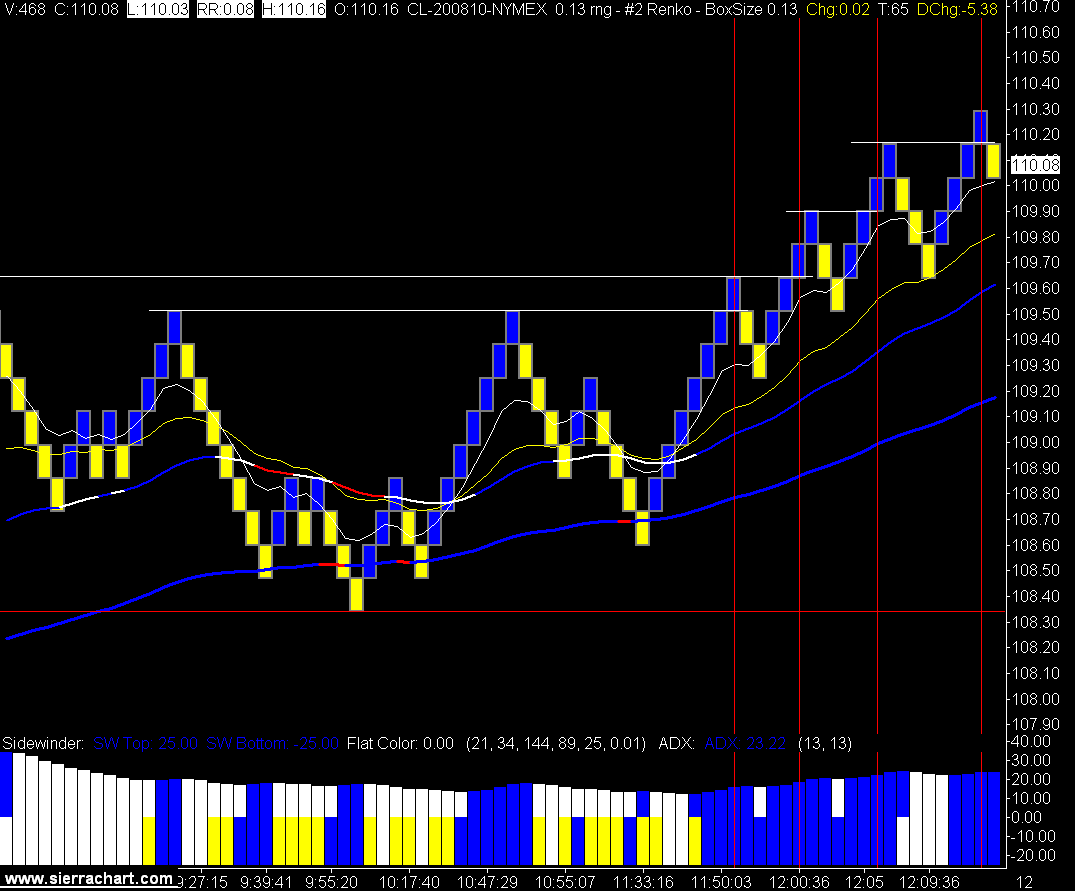
Nine signals in the day, I took the first 6 and then quit with 4 BE + 1s, 1 full stop, and 1 partial stop.
The crude oil contract came close to going limit down this morning, but then spent the rest of the day slowly grinding upward.
In case your wondering what happens to crude oil if it goes limit up or down, I revisited that scenario this morning.
Maximum Daily Price Fluctuation
"$10.00 per barrel ($10,000 per contract) for all months. If any contract is traded, bid, or offered at the limit for five minutes, trading is halted for five minutes. When trading resumes, the limit is expanded by $10.00 per barrel in either direction. If another halt were triggered, the market would continue to be expanded by $10.00 per barrel in either direction after each successive five-minute trading halt. There will be no maximum price fluctuation limits during any one trading session." Source: NYMEX Web Site
Our risk management kept us safe and we shall see where we go tomorrow.
$100 oil is not far away.
13 Tick Renko Crude Oil Charts (click on chart to view)

Right.
Nine signals in the day, I took the first 6 and then quit with 4 BE + 1s, 1 full stop, and 1 partial stop.
The crude oil contract came close to going limit down this morning, but then spent the rest of the day slowly grinding upward.
In case your wondering what happens to crude oil if it goes limit up or down, I revisited that scenario this morning.
Maximum Daily Price Fluctuation
"$10.00 per barrel ($10,000 per contract) for all months. If any contract is traded, bid, or offered at the limit for five minutes, trading is halted for five minutes. When trading resumes, the limit is expanded by $10.00 per barrel in either direction. If another halt were triggered, the market would continue to be expanded by $10.00 per barrel in either direction after each successive five-minute trading halt. There will be no maximum price fluctuation limits during any one trading session." Source: NYMEX Web Site
Our risk management kept us safe and we shall see where we go tomorrow.
$100 oil is not far away.
13 Tick Renko Crude Oil Charts (click on chart to view)
6/03/2008
Trading Survival 101
Crude Oil Chart (click on chart to view)

Today was tough trading with a slow gradual decline in the market throughout the day. In hindsight the trade for today was get short at NYMEX open and flat at NYMEX close.
However that is easy to see now.
How does a trader survive periods like this, when the signals are getting stopped and the winners are not running?
Risk Management.
A sound risk management policy is required by all traders to preserve capital, as a trader without capital is a trader looking for a job. This is the most important policy in the start up phase of the trading business. Without sound risk management rules, and adherence to those rules the business will not survive.
Our thesis for the risk management policy is based on the principal that capital is scarce. If capital was not scarce it would have no value. We are willing to accept the trade off of lower overall returns by not trading all signals if we have hit our daily, weekly, or monthly stop in order to reduce our “risk of ruin”.
One of the key success factors of the successful trader is sufficient capital. The risk management policy is in place to ensure that capital remains sufficient.
We have seen large financial institutions fail (Barings Bank & Long Term Capital Management) or almost fail (Societe Generale) due to “rogue traders” or position sizing issues. These billion dollar institutions had large and robust risk management / compliance departments on hand and still failed to stop multi billion dollar trading losses.
The individual trader has no such department, if you choose to ignore your risk management rules no one will stop you. Thus the discipline to adhere to your rules will be the determining factor in your success or failure.
Our Risk Management Policy is as follows:
1) Trading capital on hand must equal to two times the minimum overnight margin required per contract traded.
2) The per trade stop loss percentage is set at maximum of 0.60% on each trade and is based on a percentage of the total trading capital
3) Weekly stop loss is set at a maximum 6.00% of total trading capital. If this threshold is hit in a Monday – Friday period trading for that week stops.
4) Monthly stop loss is set at a maximum of 10.00%. If this threshold is hit in a calendar month trading for that month stops.
5) If any of the trade plan’s rules are not adhered to, trading for that day stops.
6) Sim trading the plan can continue if a stop limit has been hit.
These are rules that we use, if you use similar rules your percentages could be quite different. The key is to have some idea of when to stop, before your broker stops you.
Today was tough trading with a slow gradual decline in the market throughout the day. In hindsight the trade for today was get short at NYMEX open and flat at NYMEX close.
However that is easy to see now.
How does a trader survive periods like this, when the signals are getting stopped and the winners are not running?
Risk Management.
A sound risk management policy is required by all traders to preserve capital, as a trader without capital is a trader looking for a job. This is the most important policy in the start up phase of the trading business. Without sound risk management rules, and adherence to those rules the business will not survive.
Our thesis for the risk management policy is based on the principal that capital is scarce. If capital was not scarce it would have no value. We are willing to accept the trade off of lower overall returns by not trading all signals if we have hit our daily, weekly, or monthly stop in order to reduce our “risk of ruin”.
One of the key success factors of the successful trader is sufficient capital. The risk management policy is in place to ensure that capital remains sufficient.
We have seen large financial institutions fail (Barings Bank & Long Term Capital Management) or almost fail (Societe Generale) due to “rogue traders” or position sizing issues. These billion dollar institutions had large and robust risk management / compliance departments on hand and still failed to stop multi billion dollar trading losses.
The individual trader has no such department, if you choose to ignore your risk management rules no one will stop you. Thus the discipline to adhere to your rules will be the determining factor in your success or failure.
Our Risk Management Policy is as follows:
1) Trading capital on hand must equal to two times the minimum overnight margin required per contract traded.
2) The per trade stop loss percentage is set at maximum of 0.60% on each trade and is based on a percentage of the total trading capital
3) Weekly stop loss is set at a maximum 6.00% of total trading capital. If this threshold is hit in a Monday – Friday period trading for that week stops.
4) Monthly stop loss is set at a maximum of 10.00%. If this threshold is hit in a calendar month trading for that month stops.
5) If any of the trade plan’s rules are not adhered to, trading for that day stops.
6) Sim trading the plan can continue if a stop limit has been hit.
These are rules that we use, if you use similar rules your percentages could be quite different. The key is to have some idea of when to stop, before your broker stops you.
Subscribe to:
Posts (Atom)