8/29/2009

'Over a Barrel, The Truth About Oil'

Interesting story from ABC News 20/20 on America and oil.
(volume is low, so turn it up)

They love to bash speculators and have some interesting things to say about us. To me, a speculator, the story moves to an opinion rather than the "truth about oil" at that point. Every commodity is traded many times over before it hits the consumer, oil just happens to be the most important and is non renewable. Hence over the next 50 years or so price will continue to go up unless some viable alternative to it is found.

If you are in the U.S. you can watch it here.


They brush over the American source of "friendly" oil, namely Canada. I wonder what percentage of Americans know that Canada supplies them with more than double the petroleum than any other country?

American Petroleum Imports
Crude Oil and Total Petroleum Imports Top 15 Countries
June 2009 Import Highlights: August 28, 2009
Monthly data on the origins of crude oil imports in June 2009 has been released and it shows that three countries exported more than 1.00 million barrels per day to the United States (see table below). The top five exporting countries accounted for 64 percent of United States crude oil imports in June while the top ten sources accounted for approximately 82 percent of all U.S. crude oil imports. The top sources of US crude oil imports for June were Canada (2.001 million barrels per day), Venezuela (1.119 million barrels per day), Mexico (1.099 million barrels per day), Saudi Arabia (0.902 million barrels per day), and Nigeria (0.769 million barrels per day). The rest of the top ten sources, in order, were Angola (0.435 million barrels per day), Iraq (0.374 million barrels per day), Russia (0.305 million barrels per day), Columbia (0.286 million barrels per day), and Brazil (0.269 million barrels per day). Total crude oil imports averaged 9.172 million barrels per day in June, which is an increase of (0.241) million barrels per day from May 2009.

Canada remained the largest exporter of total petroleum in June, exporting 2.529 million barrels per day to the United States, which is an increase from last month (2.206 thousand barrels per day). The second largest exporter of total petroleum was Venezuela with 1.237 million barrels per day.

Total Imports of Petroleum (Top 15 Countries)
(Thousand Barrels per Day)
Country YTD 2009
CANADA 2,417
VENEZUELA 1,180
MEXICO 1,274
SAUDI ARABIA 1,084
NIGERIA 679
RUSSIA 638
ALGERIA 484
ANGOLA 547
IRAQ 471
COLOMBIA 283
BRAZIL 356
UNITED KINGDOM 262
VIRGIN ISLANDS 306
KUWAIT 174
NORWAY 136

Source: U.S. Government, Department of Energy, Energy Information Administration

8/27/2009

The Swami Speaketh

I find you odd.

Yes, you.

You never know what kind of post topic is going to push trader's buttons, so to speak. Jules said I was sounding swami like with my previous post. The EIT (exceptional Irish trader) had told me the same thing after he read that post. Ok he actually called me guru like.

I found this all rather offensive as I thought I had just posted a blog stating that I don't want to be your guru.

Maybe I do?

No

I don't.

I thought my point about what market do you trade was important. I still do. I think it's very important. In fact I think it is the most important factor after money management. So I offered what I thought was a very simple way to gauge different markets in order to see if there might be something else out there that you could trade. There may be something better than crude oil, if so let me know. Crude isn't always the best thing to trade as there are many posts on this blog with me whining about the lack of signals on crude oil.

Anyway I thought it was important but I get the feeling that you don't. Maybe I didn't say it right, or maybe I sounded too swami like. If so I apologize.

What if all our plans, technical analysis, indicators, systems, didn't matter? What if the only thing that mattered was a market that will get in a trend and stay there for a while? If that were the case, or at least partially the case then maybe we should take a little time and examine the different products there are to trade. Maybe we should spend more time on that rather than hours of studying whether a 34 EMA is better than a 21 EMA?

You can look at daily or hourly charts with the ATR as a guide to quantify the products range. It doesn't really matter how you measure as long as you apply the same measurement to all the markets you want to look at.

That leads me to another point, the market you want to look at. People seem hesitant to look at something else, they get very attached to their market and they don't want to leave it. I know I am the same way, slow to change.

You don't have to change, just look. Measure a few different markets and if something jumps out at you sim trade it for a while. Yes the power of sim, you don't have to dive into the crude oil pit head first (oops I let that crude bias slip out there) you can sim trade.

Why not?

Since I'm wagging crude's tail today have a look at the chart. I know, I know, you're saying, will he just shut up and post some charts!

Fine, be that way and since I am not your Swamiguru you can just look at the shiny chart and forget everything I said. :)

2 Minute Crude Oil Chart
I took the first two and passed on the last two.

8/25/2009

Is it the market or me?

What makes a system perform better some days or weeks than other times? Is it the trader or the market? It can be both but let's assume the trader has his head on straight and is functioning as he should. Maybe I should say she if we are talking about a functional trader. :)

If the trader is on her game then the only other variable is the market. We trade the same system every day but we trade it in market conditions that change every day. The eternal question is, has the market changed so dramatically that my system doesn't work anymore? I think the answer is yes and no. The market may have changed to the point where your system doesn't work as well as it once did, but the market will change again and your system will work again.

What to do?

Risk management rides to the rescue again. Remember we are assuming the trader is following the rules, so the risk management rules should keep you whole until the market returns to "normal".

There is one other thing we can do besides sit on the sidelines. We can trade multiple markets. I am currently trading crude oil, soybeans, and Russell 2000 futures, but I don't trade all of them every day. In June soybeans were the gift that gave every day, in July and August they have been terrible. Crude oil has been moving nicely and the Russell has its moments as well.

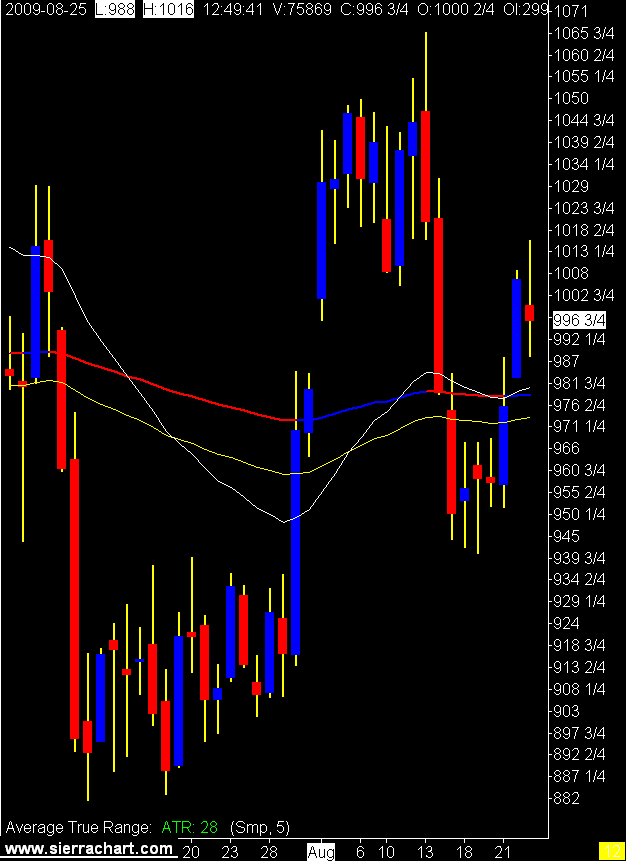
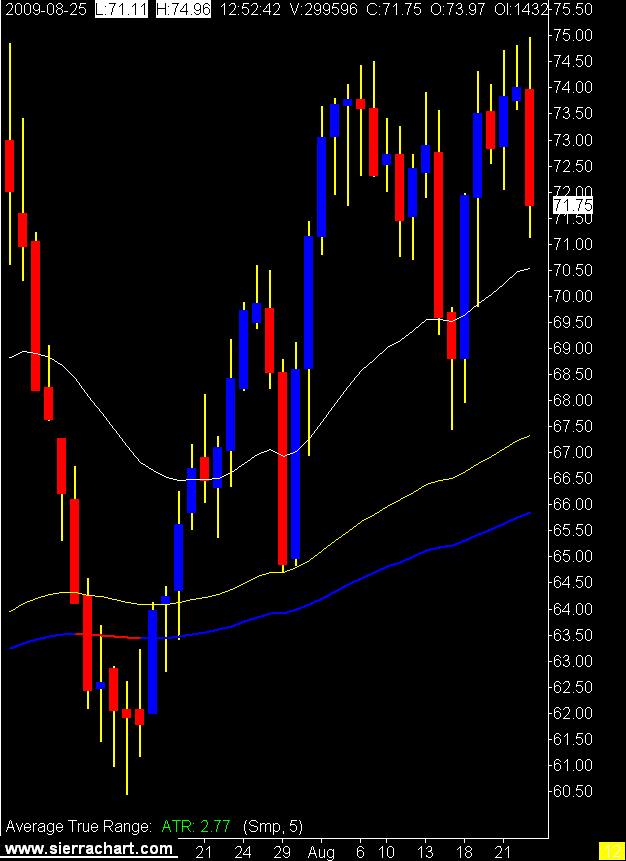
How do you tell if your market is moving? Yes I know you look at it. But is there some math we can apply? For me the ATR (average true range) is a nice guide. Below you see 3 daily charts of the markets I trade. You can see that soybeans keep going flat with crude and the Russell in a nicer trend. You can see that now, looking backwards, as always it's a little harder when it’s actually happening or more precisely when the market conditions are actually changing.

I use a 5 period ATR (5 days average true range) to give me a number. If you track that number, or watch the line, you are given an absolute value of how your market is performing in terms of range.

You need to understand what the ATR number means in ticks for your product. As we are trying to take a little meat out of the middle of the market the larger the sandwich, the easier it is to find that middle. If that makes any sense. :)
So for me, the product with the largest range is the best one to day trade.

Try it and see if it has any value for you.

Daily Russell 2000 Chart
Daily Soybean ChartDaily Crude Oil Chart From these charts you see that the Russell's ATR in ticks is 136, soybeans 112, and crude oil at 277.

For my way of thinking and trading, crude is the man.

8/24/2009

Are Great Traders Born or Taught?

The whole turtle trader experiment was done to answer that question, nature vs nurture. The prevailing answer seems to be it can be taught as most of the traders succeeded in the experiment. However when you read about the traders from that test, the majority failed after they left the tutelage of Richard Dennis and William Eckhardt and tried trading on their own.

I think it can be taught but not everyone has the mind set, or the nature, to succeed in this business. It is a strange business.

How about guitar players? Could this be taught?


I wish I could do that.

I think I could take lessons and practice for years and never be able to play the guitar like those two guys. My uncle can play the guitar and banjo and has never had a lesson in his life. He just listens to the music and then plays it. How can that be? Think about that, it's crazy.

So we know that trading and music can be taught and if you practice enough you may become good. But can you truly become great, or is greatness determined by our genetics?

Hmmmm.

Way of the Turtle: The Secret Methods that Turned Ordinary People into Legendary Traders

The Complete TurtleTrader: The Legend, the Lessons, the Results

8/20/2009

Bloggeritis

Trader Bloggeritis: a common malady recognized by the patient’s incoherent ramblings about ox entrails and other technical indicators.

When I stopped blogging in March I said I wasn't sure what I wanted to do with this thing and wouldn't start writing again until I was sure.

Well I started again in June without any clear direction of what I wanted to do with the blog. I know what I don't want, I don't want to tell anyone how to trade.

I find that when I post charts of my trades I get people wanting to copy my methods, and as I have said many times that will not work for anyone. If you show charts of winning trades people think you are a genius, if you show charts of losing trades people think you are a moron.

Neither is true. I'm sure I fall somewhere in between those two walks of life. I'm happy with where my trading is at and I don't want to debate it, defend it, or glorify it. I'll just keep it to myself, thanks.

I love trading and find everything about this business fascinating. It appeals to my never ending curiosity about how business, economies, and capital markets work. There are so many moving parts that the quest to figure it all out is never ending.

The change is I am not going to post as often or as many charts as I did before. If I come across something that sheds some light on the subject, or if I have the occasional original thought I will post it. I will also post charts if there is a reason to post a chart, not just because another day is over.

I do enjoy the comments on the blog and it is my hope that the comments will increase in volume. As independent traders will live in an isolated work place and these types of forums are vital to keep us sane. Or to confirm we're insane.

To those who contribute regularly, thank you. To the silent majority, don't be so shy.

Solfest

8/19/2009

Know Thyself

So if the key to successful trading is all in my head then it would make sense to have some understanding of just what is going on inside my head. To long time readers this may be a frightening thought, but hey everyone likes to stare at car accidents so why not this.

I took the Myers Briggs personality test a couple of years ago and incorporated the results into a personality profile within my business plan. The idea being I wanted to see how my personality helps and or hurts my trading efforts. I think the result was somewhat useful and if you have not done this it may be worth the effort.

I'm not going to post any links to a Myers Briggs test due to copyright laws, you can do your own search and take it from there.

Here is the section from my business plan.

Personality Profile:

My individual strengths and weaknesses that will affect the emotional business of trading money are derived from my personality traits which have been described by the Myers Briggs Personality Profile as INTJ (Introverted Intuitive Thinking Judging).

“This personality type is described as the most self-confident of all the types, having "self power" awareness. Found in about 1 percent of the general population, the INTJs live in an introspective reality, focusing on possibilities, using thinking in the form of empirical logic, and preferring that events and people serve some positive use. Decisions come naturally to INTJs; once a decision is made, INTJs are at rest. INTJs look to the future rather than the past, and a word which captures the essence of INTJs is builder - a builder of systems and the applier of theoretical models.” David Keirsey & Marily Bates, Please Understand Me, Character and Temperament Types

“INTJs are perfectionists, with a seemingly endless capacity for improving upon anything that takes their interest. What prevents them from becoming chronically bogged down in this pursuit of perfection is the pragmatism so characteristic of the type: INTJs apply (often ruthlessly) the criterion "Does it work?" to everything from their own research efforts to the prevailing social norms. This in turn produces an unusual independence of mind, freeing the INTJ from the constraints of authority, convention, or sentiment for its own sake.” Marina M. Heiss

While I can see there are many INTJ attributes that are conducive to trading, the drive for perfection can be problematic as perfection in trading does not exist.

I have to be conscious of this and utilize statistical data to form truths that override my desire to never be wrong. In trading you can be wrong more often than right and yet still be very profitable if you stick to the plan. All trading plans will have a series of consecutive losing trades and as these trades stack up and I am “wrong” over and over my tendency is to want to abandon the plan and start the research process over again in the search for perfection. I have to consistently remind myself this pursuit is fruitless. I also must frame each losing trade based on was it a valid setup or not, did I follow the plan, or not. If the losing trade met the plan criteria then it’s a good trade.

In other words I was not “wrong” if I followed the plan. I can only be “wrong” when I fail to follow the plan.

This desire for perfection has manifested itself in my trading history with what is known as “revenge trading”. Revenge trading is re entering positions immediately after a trading stop out in order to prove that I was right in the first place. This is why I have programmed rules about when I can take another position after a stop out, to stop any random revenge trades.

Under extreme stress, fatigue or illness these characteristics can appear in an INTJ:

• doing things to excess - e.g.: eating, drinking or exercising
• acting very impulsively, perhaps starting off more projects than the INTJ could hope to accomplish
• expressing emotions in an intensive and uncontrolled way
• being very sensitive to criticism
• asking for lots of information that is irrelevant

Summary – INTJ

Contributions to the Organization
• Provide strong conceptual and design skills
• Organize ideas into action plans
• Work to remove all obstacles to goal attainment
• Have strong visions of what the organization can be
• Push the organization to understand the system as a whole with its complex interaction among parts

Leadership Style
• Drive themselves and others to attain the organization's goals
• Act strongly and forcefully in the field of ideas
• Can be tough-minded with others
• Conceptualize, design, and build new models
• Are willing to relentlessly reorganize the whole system when necessary

Preferred Work Environment
• Contains decisive, intellectually challenging people focused on implementing long-range visions
• Allows privacy for reflection
• Efficient
• Includes effective and productive people
• Encourages and supports autonomy
• Opportunities for creativity
• Task-focused

Potential Pitfalls
• May appear so unyielding that others are afraid to approach or challenge them
• May criticize others in their striving for the ideal
• May have difficulty letting go of impractical ideas
• May ignore the impact of their ideas or style on others

Suggestions for Development
• May need to solicit feedback and suggestions
• May need to learn how to appreciate others
• May need to learn when to give up an impractical idea
• May need to focus more on the impact of their ideas on people